HIPAA Security Rule update

    For multi-location medical groups

    HIPAA compliance for multi-location groups, one program, every site.

    Live Compliance runs the HIPAA program for multi-location medical groups: one organization-wide risk analysis, policies and training that roll up by location, exclusion checks on everyone, offboarding that closes every door, and a named compliance team on every plan.

    Or request a call

    ~10 minutes · No credit card · No call required

    The compliance lead sees everything; each location sees its part. Multi-location management with one roll-up view and human resources information system (HRIS) integrations are included on Enterprise.

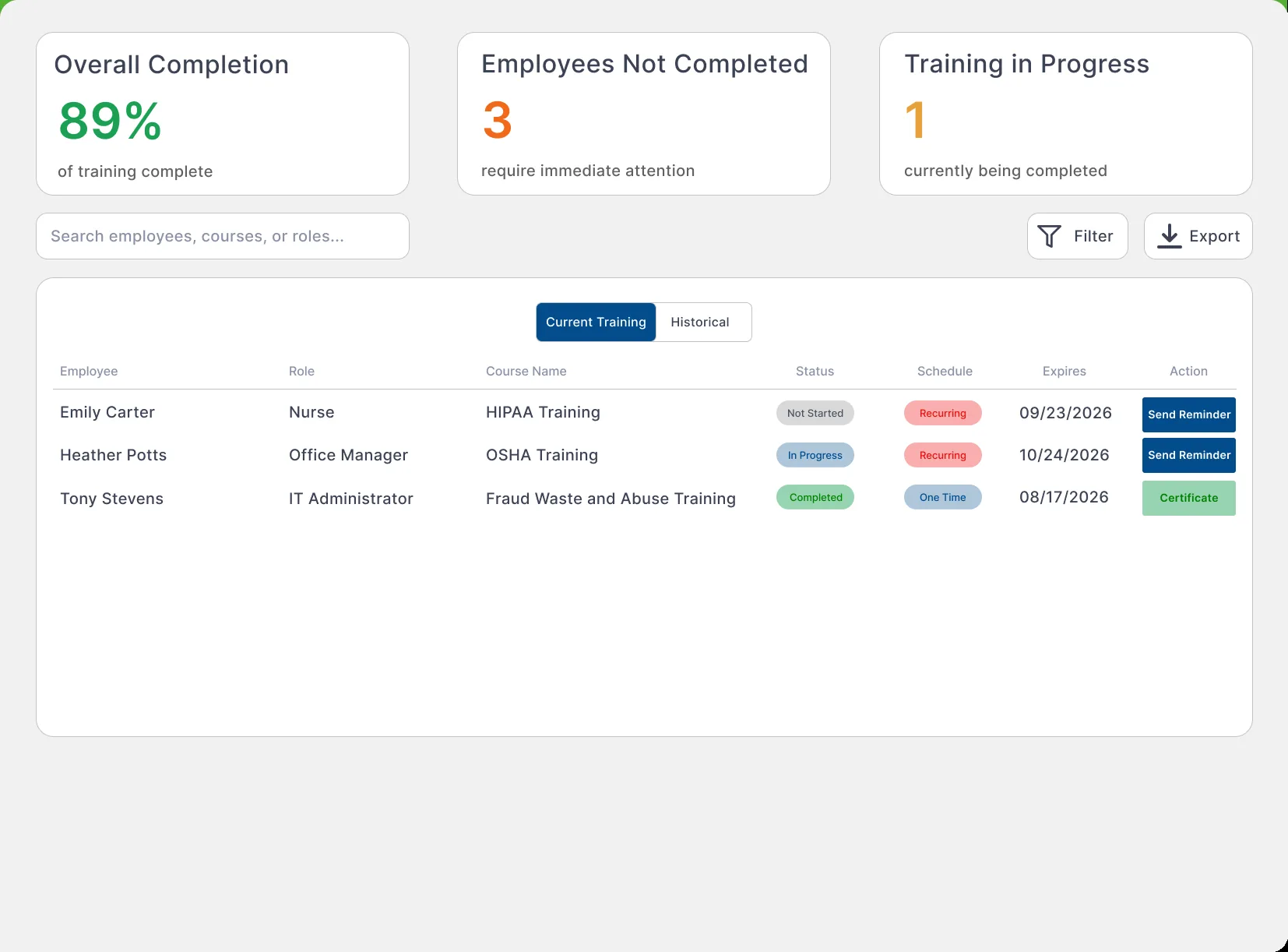
    The training screen: overall completion, employees not completed, and each employee with their role and completion status.

    Completion rolls up, site by site, person by person

    Where it goes wrong

    Where multi-location programs actually fail.

    A multi-location group's compliance risk multiplies by site: every location has its own staff, devices, and habits, and the program is only as strong as the location nobody is watching.

    01

    The risk analysis covers headquarters and samples the rest

    The Security Rule requires an accurate and thorough risk analysis of the risks to the organization’s ePHI, wherever that ePHI lives. For a group with many locations, an analysis that covers the main office and assumes the satellites look the same does not meet the standard, and it is one of the first documents the Office for Civil Rights asks for, with a dedicated Risk Analysis Initiative behind its recent enforcement.

    45 CFR 164.308(a)(1)(ii)(A)

    In the programOne risk analysis in the platform with every location inside it, kept current as locations are added, and the roll-up view that shows where the gaps are.

    02

    Every site runs its own version of the policies

    HIPAA requires written policies and procedures, reviewed, updated, and retained for six years, and a multi-location group usually has as many versions as it has front offices: one site on the 2024 binder, one on a fork someone edited locally, one on nothing anyone can produce. An auditor reads them as one organization and asks why the program disagrees with itself.

    45 CFR 164.530(i)–(j) · 164.316

    In the programOne set of policies in the platform with review dates and per-person acknowledgments at every site, so every location runs the same current version.

    03

    One chart system, and everyone can see everyone

    Consolidating on one practice-management or chart system is usually the point of growing, and it is also where access quietly goes wide. The front desk at one site can pull a patient seen only at another, a float staff member keeps every location’s permissions after the rotation ends, and a manager who moved up two years ago still holds the old role on top of the new one. The Security Rule expects written procedures for granting, reviewing, and changing each user’s access and for regularly reviewing system activity, and the Privacy Rule requires the practice to decide which roles need which patient information and to limit access to that minimum necessary. Neither is satisfied by a system that technically could scope access if someone configured it. The question an investigator asks after an internal snooping complaint is not whether the software supports restrictions, it is who approved this person’s access and when it was last looked at.

    45 CFR 164.308(a)(4) · 164.308(a)(1)(ii)(D) · 164.502(b) · 164.514(d)(2)

    In the programRoles and permissions live beside the employee record for every location, access changes are tied to the same onboarding and transfer checklists as training, and the review is a scheduled task with a date rather than an intention.

    04

    Training completion lives in a different spreadsheet per site

    HIPAA requires security awareness and training for all workforce members, with documentation retained. At one location that is a checklist; across many it is version chaos, and an auditor asks for the records, not the intention.

    45 CFR 164.308(a)(5) · 164.530(b)

    In the programTraining lands by role at every location, new hires are trained on arrival with a dated record, and completion rolls up by site on one dashboard.

    05

    Exclusion screening happens at hire and never again

    If an excluded person works for you, Medicare, Medicaid, and other federal health care programs will not pay for the items or services that person furnishes, including office, billing, and management work. The practice can owe the money back and face civil money penalties. The Office of Inspector General (OIG) updates its List of Excluded Individuals/Entities (LEIE) every month. No federal rule sets how often a provider must check it, but OIG says screening employees and contractors each month best minimizes that liability, and many state Medicaid programs require monthly checks. Across hundreds of employees and many locations, manual monthly checks quietly stop.

    OIG Special Advisory Bulletin (2013) · 42 CFR 1001.1901 · 42 CFR 455.436

    In the programExclusion checks run on hire and monthly on every plan, against the OIG, SAM.gov, and state lists, with the verification record kept automatically.

    06

    People leave one site and keep access at another

    The Security Rule expects procedures for ending access to ePHI when someone’s job or contract ends, and for regularly reviewing who is using the system. Multi-site groups are where that fails first: someone resigns at one office, the directory at the next office is never told, and the login keeps working for months. Memorial Healthcare System settled for $5.5 million in 2017 over exactly this pattern: credentials belonging to someone who had already left an affiliated physician office went on working, were used against the hospital system’s records every day for a year, and went unnoticed because nobody was reading the activity logs.

    45 CFR 164.308(a)(3)(ii)(C) · 164.308(a)(4) · 164.308(a)(1)(ii)(D)

    In the programThe employee record, the departing-employee checklist and the device register share one system, so closing an account and getting the laptop back are steps in the same signed process rather than two teams hoping the other did it.

    Jim Johnson, Founder of Live ComplianceReviewed by Jim Johnson, Founder · Live Compliance
    Last reviewed November 2026

    Accuracy and legal note. Plain-language summary of the HIPAA Rules (45 CFR 160.402, 164.103, 164.105, 164.308, 164.316, 164.502, 164.514, 164.530) and OIG exclusion guidance with 42 CFR 1001.1901 and 455.436, accurate as of November 2026. Regulations change. This is general educational information, not legal advice. Verify current requirements at hhs.gov/hipaa or with your compliance counsel.

    Straight answers

    Multi-location groups and Live Compliance, in plain words.

    Live Compliance is the HIPAA compliance program for medical groups working from more than one address: a single record spanning every site, run with a named compliance team on every plan.

    It sits alongside whichever IT provider each office already uses rather than displacing one. What changes is the paperwork: an auditor reads one program end to end instead of a separate binder at every address.

    • Since 2010
    • 500+ organizations
    • Multi-location roll-up on Enterprise
    • Named team on every plan
    • 100% audit success rate

    One, covering everything. The rule asks for an accurate and thorough assessment of the risks to the ePHI your organization holds, and it does not carve out the offices that are inconvenient to visit. A group working from twelve addresses needs an analysis that reaches all twelve and the systems they share, not a representative sample plus an assumption about the rest. That document is among the first the Office for Civil Rights asks for, and its Risk Analysis Initiative sits behind a run of recent enforcement.

    Each covered entity must designate a privacy officer and a security officer, and one qualified person can hold both roles across locations of the same organization. HIPAA does not require a separate officer at each location. What it does require is the designation in writing, and in practice every site needs to know who that person is and how to reach them. If your practices are separate legal entities, each one needs its own designation unless they have formally designated themselves a single affiliated covered entity.

    Not under federal law. No federal statute or regulation tells a provider how often to check the Office of Inspector General's (OIG) List of Excluded Individuals/Entities, but OIG updates the list every month and says screening employees and contractors each month best minimizes the risk of repayment and civil money penalties. Some states go further: state Medicaid agencies must check enrolled providers monthly, and many state Medicaid programs require their providers to screen staff and contractors monthly against the federal list and the state's own list. Across hundreds of employees and many sites, the practical question is whether anyone can prove the checks happened. Live Compliance runs them on hire and monthly, on every plan, with the record kept.

    Every workforce member gets it, the curriculum follows the role rather than the ZIP code, and a new hire is trained on arrival with the date recorded. Completion then feeds a single view the compliance lead can read office by office. The federal rule wants both the training and the documentation proving it happened, and keeping that proof in a different spreadsheet at every address is how groups lose it. Some states add their own deadlines; Texas, for example, requires training within 90 days of hire.

    Yes, that is what the Enterprise plan is for. Training, policies, risk assessment status and exclusion checks sit on a single record that reads either office by office or all at once, and the HRIS integrations keep the roster honest as people join, move and leave. The compliance lead gets the whole board; a site manager gets their own column.

    Sometimes. If your locations are all one legal entity, you are already one covered entity and need no special designation. If your practices are separate legal entities under common ownership or control, HIPAA lets them designate themselves as a single affiliated covered entity. The group can then run one program: one privacy official, one security official, one set of policies and procedures, and one notice of privacy practices. The designation has to be in writing and kept for six years, and every member stays responsible: each one can be held jointly and severally liable for a violation by the group. An affiliated covered entity is different from an organized health care arrangement, where separate covered entities, such as a hospital and its medical staff, keep their own programs but may share a joint notice. Whether your structure qualifies is a question for your attorney. (Source: 45 CFR 164.105(b)-(c), 164.103, 160.402(b)(2), 164.520(d).)

    Published, like every other price here: $399, $895 or $1,450 a month, plus $8.33 per employee per month, billed annually, with nothing added on top. The multi-location roll-up and the HRIS integrations sit on the Enterprise plan at $1,450. Example: 20 employees. Enterprise is $1,616.60 a month.

    See where your program stands before an auditor does.

    Get your free 10-minute audit-readiness score. Then, if you want it, the guarantee: audit-ready in 60 days, or we keep working at no additional cost until you are.

    Or talk to a Specialist

    ~10 minutes · No credit card · No call required

    500+
    healthcare organizations
    100%
    audit success rate
    2010
    protecting healthcare since